Draft Local Plan Regulation 19 Document
Other elements in this consultation
Chapter 3 – Spatial Portrait and Key Issues
3.1Buckinghamshire is a diverse, attractive and strategically important county located within the Southeast of England. The county contains a wide range of urban and rural communities, including principal towns, market towns, villages and extensive areas of countryside and nationally significant landscapes. Buckinghamshire benefits from strong economic links, strategic transport connections and a high-quality natural and historic environment, making it an attractive place to live, work, visit and invest.
3.2The county faces several significant opportunities and challenges. Its location and connectivity provide substantial potential for sustainable growth, investment and economic development. At the same time, Buckinghamshire’s valued landscapes, areas of Green Belt, rich biodiversity and historic character place important constraints on the scale, location and form of development.
3.3Key issues facing Buckinghamshire include meeting housing needs and improving affordability, supporting sustainable economic growth and improving productivity, delivering infrastructure to support development, improving transport connectivity and accessibility, responding to environmental pressures, protecting and enhancing the natural and historic environment, addressing health inequalities, and responding to the needs of a growing and ageing population. Balancing these competing pressures is central to shaping how Buckinghamshire evolves over the plan period to 2045.
3.4The following sections provide a spatial portrait of Buckinghamshire and identify the key opportunities and challenges facing the county. They provide an overview of the county’s communities, economy, environment and infrastructure, alongside the factors that will influence future growth and development. Together, these characteristics and issues provide the evidence-led context which underpins the Vision, Objectives and Spatial Strategy of the Buckinghamshire Local Plan.
3.5The characteristics, opportunities and challenges identified throughout this chapter highlight the need to balance future growth with the protection of Buckinghamshire’s valued natural and historic environment, whilst ensuring that development is supported by appropriate infrastructure and contributes to sustainable and inclusive communities.
3.6The Local Plan therefore plays a central role in establishing a clear and coordinated strategy for managing growth, addressing inequalities, responding to environmental pressures and supporting the long-term prosperity, health and wellbeing of Buckinghamshire’s communities.
Location and Geography

3.7Buckinghamshire occupies a key strategic position within the Southeast of England and covers an area of approximately 604 square miles (1,564 square kilometres).
3.8The county lies within the Oxford-Cambridge Growth Corridor and forms an important link between London, Oxford, Milton Keynes and Cambridge. Buckinghamshire benefits from strong economic relationships and functional linkages with neighbouring authorities, particularly London and the wider Southeast.
3.9Buckinghamshire is well connected by a network of strategic transport infrastructure, including the M40, M25 and M4 motorways, national rail services and London Underground connections. The county also benefits from its proximity to London Heathrow and London Luton airports, supporting economic activity, tourism and wider connectivity.
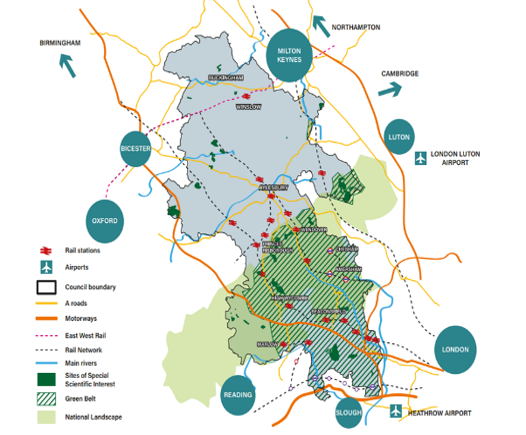
3.10Figure 1 illustrates Buckinghamshire's strategic location, key transport connections and environmental designations, including the Green Belt and Chilterns National Landscape. Together, these factors play an important role in shaping the distribution, scale and form of development across the county.
Population, Communities and Place
3.11Buckinghamshire has a population of approximately 553,000 people, representing an increase of 9.5% since 2011, which is higher than the national average growth rate of 6.6% for England over the same period (ONS Census 2021). Population distribution varies across Buckinghamshire, with the south more densely populated and the north generally more rural and sparsely populated. Population growth has been particularly significant within the north and central planning area, which experienced growth of around 10.4%.
3.12Buckinghamshire has a diverse settlement pattern comprising larger urban centres, market towns, villages and rural communities. The county’s principal urban areas are Aylesbury and High Wycombe, which provide significant concentrations of housing, employment, retail, education, leisure and public services.
3.13A network of market towns, including Amersham, Beaconsfield, Buckingham, Chesham, Marlow, Princes Risborough, Wendover and Winslow, also plays an important role in supporting local communities and providing services, employment opportunities and transport connections across the county. These settlements contribute strongly to Buckinghamshire’s distinct character, historic identity and sense of place.
3.14Settlement patterns vary across the county. The south of Buckinghamshire generally has stronger economic and commuting relationships with London and surrounding urban areas, whilst the north is more rural in character, with larger areas of open countryside and agricultural land. These differences influence patterns of movement, infrastructure provision, housing demand and access to services.
3.15Buckinghamshire’s population is both growing and ageing, creating increasing and changing demands for housing, healthcare, infrastructure, employment and community facilities. Between 2011 and 2021 the number of residents aged 65 and over increased by 23.2% (ONS Census 2021). This demographic influences the scale, type and location of development required over the plan period, whilst increasing demand for accessible and adaptable housing, specialist accommodation, healthcare provision and support services.
3.16Whilst Buckinghamshire performs relatively well across many social and economic indicators, health inequalities remain across parts of the county, with life expectancy in the most deprived areas estimated to be around 5.4 years lower than in more affluent areas. At the same time, there is a need to ensure that younger households and working-age residents can access suitable housing, employment opportunities and services. Balancing these changing demographic pressures and reducing inequalities will be an important consideration for the Local Plan to support inclusive, well-connected and sustainable communities.
3.17Many rural communities contribute positively to Buckinghamshire’s landscape character, biodiversity, tourism and local identity. However, some settlements face challenges relating to accessibility, transport connectivity, housing affordability, digital connectivity and access to local services and facilities. These challenges can contribute to social isolation, reduced accessibility and inequalities between rural and urban communities.
3.18Maintaining sustainable rural communities presents a key challenge, particularly in balancing the need to support development, services and connectivity with the protection of the countryside and landscape character. Ensuring that rural areas remain vibrant, accessible and well-connected, whilst supporting sustainable patterns of development and protecting their distinctive character, is therefore an important consideration for the Local Plan.
3.19Buckinghamshire contains a rich and distinctive historic, built and natural environment, including market towns, villages, conservation areas, listed buildings, historic parks and gardens, archaeological assets and nationally important landscapes. Protecting and enhancing local character, heritage and landscape quality whilst accommodating future growth represents a significant challenge for the Local Plan.
3.20Ensuring that new development is well designed, sustainable and responsive to local context is essential to maintaining Buckinghamshire’s sense of place and delivering attractive, sustainable and high-quality environments. Balancing the need for homes, jobs and infrastructure with the protection of the county’s environment, heritage and landscape character is therefore a key consideration in planning for future growth.
Economy and Employment
3.21Buckinghamshire has a strong and diverse economy, benefiting from its strategic location within the Southeast, the Oxford-Cambridge Growth Corridor, the Thames Valley and the wider Southeast The county generates approximately £19.2 billion in economic output and supports around 285,000 jobs across more than 31,000 businesses, around 98% of which are small and medium-sized enterprises (Buckinghamshire Economic Growth Plan, 2025).
3.22Economic activity is spatially diverse and supported by several established sector clusters and specialisms. These include high-performance engineering around Silverstone, the Westcott Space Cluster, life sciences activity associated with Stoke Mandeville and South Buckinghamshire, alongside a growing health and innovation sector, and the nationally significant film and media cluster at Pinewood. These clusters play an important role in attracting investment, creating high-value employment opportunities and reinforcing Buckinghamshire’s position within the wider Southeast and national economy.
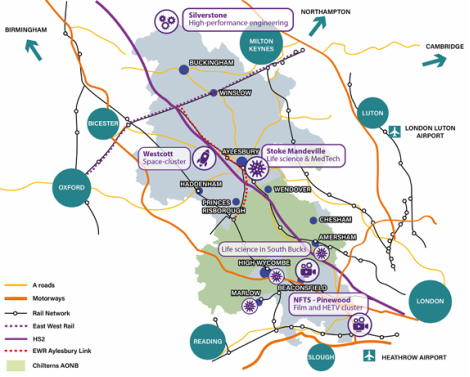
3.23Figure 2 illustrates the spatial distribution of Buckinghamshire’s key economic clusters and their relationship to strategic transport infrastructure and surrounding economic centres. This highlights the county’s role as part of a wider interconnected economic geography and the importance of connectivity in supporting economic growth.
3.24Despite these strengths, Buckinghamshire faces several economic challenges. Analysis in the Buckinghamshire Economic Growth Plan (2025) indicates that productivity growth has been relatively weak over recent years. Output per worker was previously above the national average prior to 2011 but has since declined to broadly align with it, with more recent trends suggesting a potential widening gap.
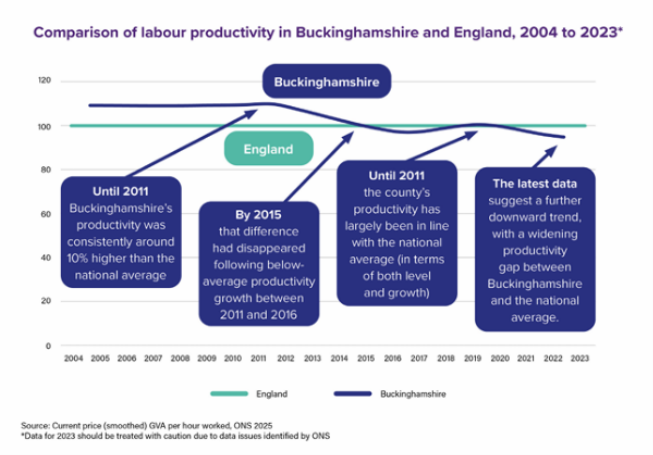
3.25As shown in Figure 3, Buckinghamshire’s productivity advantage relative to the national average has reduced over time. This reinforces the need to support innovation, skills development, infrastructure investment and the growth of higher-value economic activity across the county.
3.26Buckinghamshire also experiences significant levels of out-commuting, reflecting its strong economic links to London and the wider Southeast. Around 12.6% of residents work in London, resulting in a net outflow of workers from the county (Buckinghamshire Economic Growth Plan, 2025).
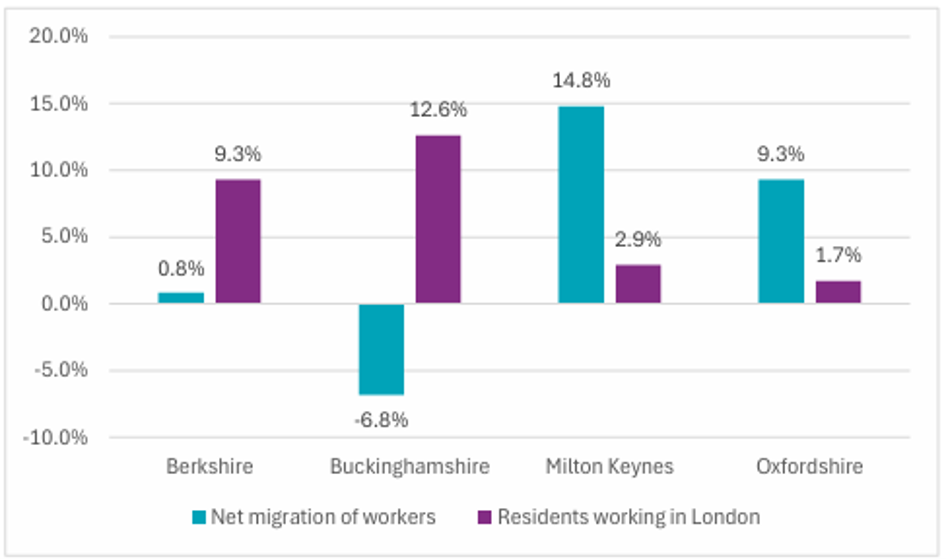
3.27Figure 4 highlights the imbalance between local labour supply and employment opportunities, with a net outflow of workers and a reliance on jobs outside the county. Whilst this reflects Buckinghamshire’s strong economic relationship with London and surrounding areas, it also indicates opportunities to strengthen local employment provision and support a more balanced local economy.
3.28The county faces a range of wider economic pressures, including housing affordability constraints, infrastructure capacity issues, skills shortages, congestion and the changing role of town centres. Increasing demand for flexible employment space, the need to support regeneration and maintain vitality within key centres, and the transition towards new ways of working continue to influence patterns of economic activity and development.
3.29Supporting sustainable economic growth, improving productivity and creating high-quality employment opportunities are therefore important priorities for the Local Plan. Responding to these challenges requires a coordinated approach which supports inward investment, innovation and business growth, whilst ensuring that economic development is aligned with infrastructure capacity, environmental constraints and opportunities, and the delivery of well-connected places.
Environment and Landscape
3.30Buckinghamshire contains a high-quality natural and historic environment, including nationally and internationally important landscapes, biodiversity assets and heritage features. Large parts of the county are rural in character and include extensive countryside, agricultural land, woodland, chalk streams and historic settlements.
3.31Approximately 32% of Buckinghamshire is designated as Metropolitan Green Belt and around 27% falls within the Chilterns National Landscape. The Green Belt plays an important role in preventing urban sprawl, safeguarding the countryside and maintaining the separation and identity of settlements. The Chilterns National Landscape is recognised for its natural beauty, landscape quality and environmental importance.
3.32Buckinghamshire also contains a significant historic environment, including around 180 conservation areas and close to 6,000 listed buildings. These heritage assets contribute significantly to the county’s distinctive character, cultural identity and sense of place.
3.33The county’s water environment forms an important part of its natural character and ecological network, including nationally important chalk streams, river valleys and watercourses which contribute to biodiversity, landscape quality and recreation. These assets are sensitive to development pressures, water stress, pollution and changes in environmental conditions.
3.34Together, these environmental assets and designations play a fundamental role in shaping Buckinghamshire’s character and identity. They contribute significantly to biodiversity, health and wellbeing, environmental quality and the attractiveness of places, whilst also influencing the location, scale and form of development that can be accommodated across the county.
3.35Buckinghamshire faces a range of environmental pressures, including flood risk, rising temperatures, pressures on water resources, biodiversity loss and the need to support sustainable and resilient patterns of growth and development. Parts of the county also experience constraints relating to water supply, wastewater treatment capacity and water quality, particularly where growth pressures and environmental sensitivities coincide.
3.36The county’s landscapes, biodiversity, green infrastructure and water resources play an important role in supporting environmental resilience, ecosystem recovery and sustainable growth. However, these assets remain sensitive to the impacts of development and wider environmental pressures, particularly in relation to chalk streams, habitats and areas at risk of flooding.
3.37Extreme weather events, including periods of intense rainfall, flooding and heatwaves, place and may continue to place additional pressures on communities, infrastructure and the natural environment. Supporting environmental enhancement, improving resilience, promoting sustainable patterns of development and travel, and ensuring the efficient use of resources are therefore important considerations throughout the plan period.
3.38Accommodating development whilst protecting and enhancing Buckinghamshire’s natural and historic environment represents a significant challenge for the Local Plan. Protecting and enhancing biodiversity, landscape character, heritage assets and environmental quality, whilst supporting low-carbon growth and ensuring that future development is supported by appropriate infrastructure and sustainable resource management, are therefore important considerations in shaping Buckinghamshire’s future growth and development.
Transport, Connectivity and Infrastructure
3.39Buckinghamshire benefits from strong strategic transport connections, including national rail services, the motorway network and proximity to London Heathrow and London Luton airports. The county’s transport infrastructure supports economic activity, commuting patterns and access to employment, services and education, whilst providing strong connections to London, Oxford, Milton Keynes and the wider Southeast.
3.40Major infrastructure projects are also shaping future connectivity across Buckinghamshire. High Speed 2 (HS2) passes through the county as part of the national high-speed rail network between London and Birmingham, whilst East West Rail (EWR) will improve east-west connections between Oxford, Milton Keynes and surrounding areas, including a new station at Winslow. These projects are expected to influence future patterns of movement, accessibility, investment and growth across the county.
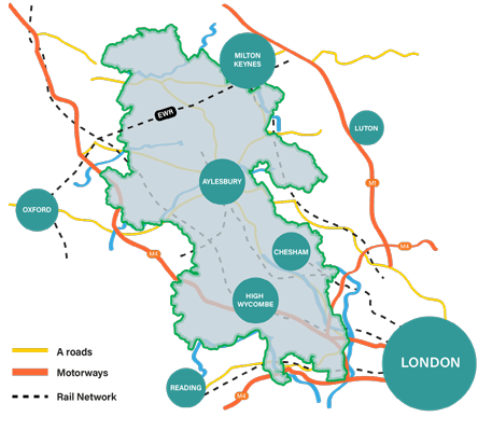
3.41Figure 5 illustrates Buckinghamshire’s strategic transport connections, including the motorway network, key A-roads and rail infrastructure, and highlights the county’s strong connectivity to London and neighbouring economic centres such as Oxford, Milton Keynes and Luton.
3.42Despite these strengths, parts of Buckinghamshire’s transport network are operating at or close to capacity, particularly around key towns, strategic routes and major transport corridors. Modelling indicates that traffic volumes are likely to increase over the plan period, placing additional pressure on transport infrastructure and connectivity.
3.43Whilst Buckinghamshire benefits from strong north-south transport connections, east-west connectivity remains more limited in some parts of the county. Public transport accessibility is also more constrained in certain rural areas, where reliance on private vehicle travel remains high. These factors can affect access to employment, services and opportunities, whilst contributing to congestion and wider accessibility challenges.
3.44Major infrastructure projects, including East West Rail and HS2, will improve connectivity and accessibility across parts of the county but do not address all existing transport and infrastructure constraints. Continued investment in transport infrastructure, public transport, active travel and digital connectivity is therefore important in supporting sustainable growth.
3.45Buckinghamshire also faces pressures on wider infrastructure provision, including healthcare, education, utilities, wastewater treatment, green infrastructure, digital connectivity and community services. Ensuring that new development is supported by the timely delivery of infrastructure is critical in maintaining sustainable, healthy and well-connected communities throughout the plan period.
3.46Transport is a significant contributor to carbon emissions across Buckinghamshire, accounting for approximately 51% of total emissions within the county. Improving sustainable and integrated transport options, including public transport and active travel infrastructure, is therefore important in supporting healthier lifestyles, reducing emissions, improving accessibility and supporting more sustainable patterns of movement across Buckinghamshire.
3.47Together, these factors highlight the need to plan for coordinated infrastructure investment, improve connectivity and accessibility, and reduce reliance on private vehicle travel whilst supporting sustainable patterns of growth. Supporting infrastructure-led development and improving accessibility across both urban and rural areas therefore remain important priorities for the Local Plan.
Housing and Affordability
3.48Buckinghamshire experiences significant housing affordability pressures, reflecting its attractive environment, strong economy and proximity to London and the wider Southeast. The county has approximately 220,727 households, with around 71% of residents owning their homes either outright or with a mortgage (ONS Census 2021).
3.49House prices in Buckinghamshire remain significantly above the national average, with average house prices estimated at approximately £479,000 in April 2026 (ONS data, 2026). In 2024, Buckinghamshire’s affordability ratio was estimated at 11.6, placing it amongst the least affordable areas in England and Wales (ONS data, 2026). This indicates that house prices are over eleven times average earnings, highlighting the scale of the affordability challenge.
3.50Affordability pressures continue to create challenges for many residents, particularly younger people, first-time buyers, families, key workers and lower-income households. House prices and private rental costs remain significantly above national averages, making it increasingly difficult for many people to access suitable and affordable housing.
3.51Buckinghamshire also faces ongoing pressures to deliver new homes, including affordable housing, specialist accommodation and a range of housing types and tenures to meet changing community needs. Using the Government's standard method, Buckinghamshire's local housing need is approximately 4,344 dwellings per year, equating to around 91,230 homes over the plan period to 2045 (MHCLG Standard Method).
3.52Meeting housing needs whilst balancing infrastructure capacity, environmental constraints and the protection of Buckinghamshire’s distinctive character and settlements represent a major strategic challenge for the Local Plan. There is also a need to ensure that housing delivery supports sustainable patterns of development and is aligned with the provision of infrastructure, services and employment opportunities.
3.53The county’s ageing population increases demand for accessible and adaptable housing, specialist accommodation and a wider range of housing choices. Ensuring that homes meet the needs of different groups within the community is therefore an important consideration throughout the plan period.
3.54Together, these pressures highlight the challenge of delivering sufficient housing to meet identified needs whilst ensuring that development is sustainable, infrastructure-led and responsive to local character and environmental constraints. Addressing housing affordability, supporting housing delivery and creating sustainable communities therefore remain central considerations throughout the plan period.
Health and Wellbeing
3.55Buckinghamshire’s natural environment, open spaces, towns, villages and countryside contribute positively to health, wellbeing and overall quality of life. Access to green spaces, leisure facilities, walking and cycling routes and community infrastructure plays an important role in supporting healthy and active communities.
3.56Whilst Buckinghamshire performs relatively well across many health indicators, inequalities remain between different communities and locations across the county. Life expectancy in the most deprived areas is estimated to be approximately 5.4 years lower than in the least deprived areas, highlighting variations in health outcomes and access to opportunities. Variations in accessibility, connectivity, housing, environmental quality and socio-economic circumstances can all influence health and wellbeing outcomes.
3.57The quality, design and accessibility of places can have a significant influence on health and wellbeing. Ensuring that communities have access to services, facilities, employment opportunities, green infrastructure and sustainable transport options is important in supporting healthy, inclusive and well-connected communities.
3.58The Local Plan has an important role in supporting healthy, inclusive and sustainable communities through the delivery of well-designed places, accessible services and facilities, active travel opportunities, green infrastructure and high-quality environments. The Buckinghamshire Design Code helps support a consistent approach to achieving high-quality design across the county.
3.59Promoting healthier lifestyles, reducing inequalities and improving access to services and opportunities will remain important considerations throughout the plan period. Supporting healthy and well-connected communities is therefore a key objective in shaping Buckinghamshire’s future growth and development.
3.60The characteristics, opportunities and challenges identified throughout this Spatial Portrait and Key Issues chapter provide the evidence-led context for the Buckinghamshire Local Plan. Together, they help inform the Vision, Objectives and Spatial Strategy, and provide the foundation for the policies and proposals contained within the Plan.


